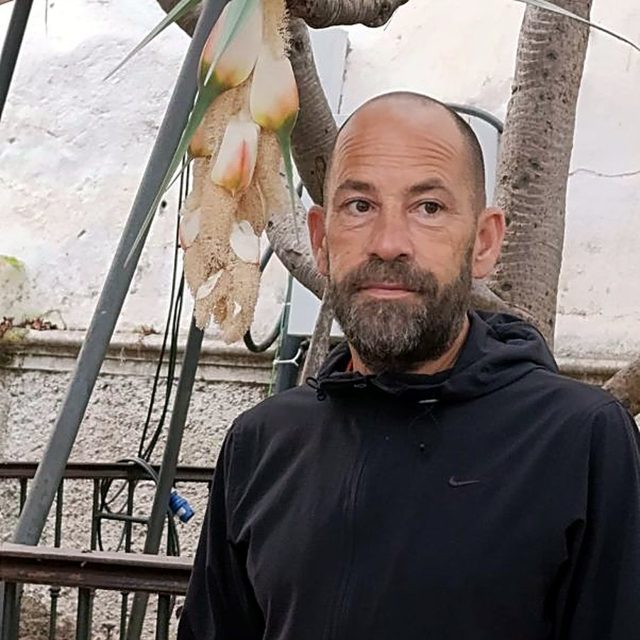
I was fifty before I found out what a relaxed jaw feels like.
James Roberts, Tenerife.
Not relaxed as a word. Relaxed as a fact — jaw, face, teeth, the whole set of them, unclenched without being told to be. I had carried the other thing for decades and never once noticed I was carrying it.
This is the top of a network of guides for men who would rather notice what is happening to them than find out later.
contented.guide — where the guides come together
Each guide here deals with one part of a man's life. It is rarely one problem. contented.guide is where it joins up: one membership across all twenty guides, and one objective, a contented life.
Reading is free, and every guide gives you ten free turns of conversation a day. Members get a hundred across the whole network, and a private console that keeps what you notice, in your own words, so something you saw in March is still there in September. You can export all of it, or delete all of it, whenever you want.
It is a single payment for a year of access. It does not renew. When the year ends, access stops, and you come back only if you need to. There is no advertising anywhere in the network, and there never will be.
I finished corporate work in 2020, at forty-five. Not a collapse and not a sabbatical — an ending. What I had assumed would feel like loss turned out to be the first quiet I had experienced in twenty years, and it took a while to recognise it as quiet rather than absence.
On my fiftieth birthday I started working on my own fascia. I expected it to be a physical project: stiffness, posture, the ordinary wear a man accumulates. It was not. It moved into something else within weeks.
The change was not in my back. It was in my face. Jaw, teeth, the muscles round the eyes, a smile that arrived without being assembled first. I had no vocabulary for any of it, because I had never had the thing it describes.
Contentment, it turns out, is not a mood. It is a physical arrangement you can be in or out of, and I had been out of it for so long that I had stopped registering the difference.
Since February 2026, I have reached a state of complete absorption regularly. Most of the time I no longer have to start the process deliberately — it arrives.
That is my experience, honestly reported. It is not a prediction about yours, and nothing here treats it as one.
Look forward. Look back exactly once.
Almost everything aimed at men our age is built on looking back — recovering something, returning to something, reversing something. That framing makes the past the destination, and it does not work.
There is one exception, and it is the whole method.
Find the best version of yourself you can actually remember. Then ask what else was true at that exact point.
Not "when were you younger". Younger is easy and useless. The question is what specific moment you recall being genuinely well in — and then, carefully, what surrounded it. Where you were living. Who you spoke to that week. What you did with your mornings. What you were not yet carrying.
Age is rarely the answer. It is almost always the least interesting variable in the list. Something else was in place, and identifying it is work that nobody else can do for you — which is precisely why it is worth doing.
From there, everything points forward. One thing changes, which changes the thing next to it, which changes something you were not paying attention to. That sequence is the entire mechanism, and it is why single fixes fail: nothing in a man moves on its own.
For life, not for a season
The closest honest analogy I have is choosing a team. Not for a match, not for a good year — for good. You do not renegotiate it when the results turn. That commitment is not a burden; it is what makes the thing mean anything at all.
I take the same view of everything in these guides. Stay with what is best, stay with it long enough for it to compound, and stop restarting. Most men do not lack effort. They lack a decision they are willing to leave alone.
The part that is not about you
A man needs a purpose, and that requirement is about to get considerably sharper. As machines take over more of what used to define a working life, the question of what a man is for stops being philosophical and becomes practical.
My answer is the next generation. Not as sentiment — as the actual reason to sort yourself out. What you are like in your fifties is what someone younger will assume is normal for a man in his fifties. That is inherited, whether you intend it or not.
It is also the most reliable motivation I know of. Doing it for yourself runs out. Doing it because someone is watching does not.
The guides
This is the apex. The work happens in the individual guides, each one narrow on purpose, each one written to be read by a man who has just noticed something and does not yet have words for it. Twenty of them are open. They are grouped here by what a man is actually facing, because that is how anybody arrives.
The body
Physical structure, and the kind of change that is too slow to notice in yourself.
Work that is being changed by SI (super intelligence), while you are still employed and still being paid. No predictions and no percentages — only what a machine already does inside your own week.
The goalposts moving while you are still in the role. Readiness rather than repair, written from nearly twenty years inside an industry that keeps being taken apart.
Drinking, and the decision about whether to stop. The busiest way into this part of the network, written on the assumption that what fitted somebody else may not fit you.
Loving somebody who drinks from a distance, at the other end of the phone.
More guides are being built. Each one is written from the ground up for its own subject — none of them is a copy of the last one with the words swapped.
What this is not
This is one man's documented experience and a structured way of paying attention. It is not medical, psychological or clinical advice, it does not diagnose anything, and it is not a treatment protocol.
If something is sharp, escalating, radiating, neurological, breathing-related, post-operative or otherwise unexplained, stop reading and get it assessed properly. The same applies to anything that frightens you about your own mood or thinking. Reflection is not the right tool for an emergency.